
Random numbers in OpenCL
Similarly to Noise functions, we also have random number generators within the random.h file.
You can import it same way as our noise patterns
OpenCL
#import "random.h"static float VEXrandom_1_1(float x)
static float2 VEXrandom_1_2(float x)
static float3 VEXrandom_1_3(float x)
static float4 VEXrandom_1_4(float x)
static float VEXrandom_2_1(float x, float y)
static float2 VEXrandom_2_2(float x, float y)
static float3 VEXrandom_2_3(float x, float y)
static float4 VEXrandom_2_4(float x, float y)
static float VEXrandom_3_1(float x, float y, float z)
static float2 VEXrandom_3_2(float x, float y, float z)
static float3 VEXrandom_3_3(float x, float y, float z)
static float4 VEXrandom_3_4(float x, float y, float z)
static float VEXrandom_4_1(float x, float y, float z, float w)
static float2 VEXrandom_4_2(float x, float y, float z, float w)
static float3 VEXrandom_4_3(float x, float y, float z, float w)
static float4 VEXrandom_4_4(float x, float y, float z, float w)Description:
This set of functions mimics VEX random() function. Depending on your scenario, you may want to input float-float4 and output float-float4
side note:
When using VEXrandom function, you could be thinking that it would create a white noise when passing lets say @P. But actually, as its vex equivalent, this function converts the floating point argument to an integer seed.
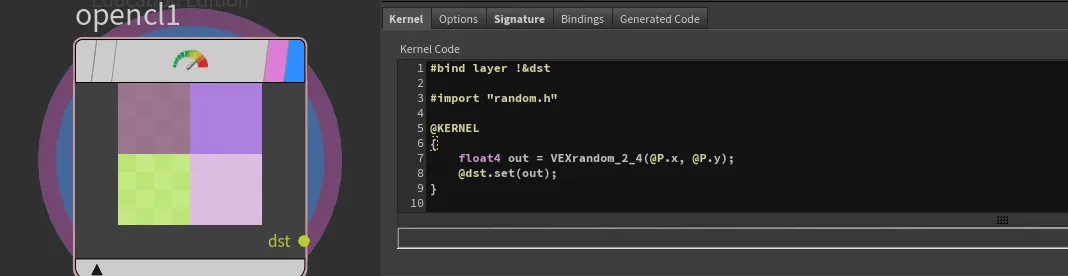
@P,@uv or use something like @iy @iy (buffer integer index)
